 Richard's Blog
Scabix: Salix, Scabiosa and a knife-tip of dishwasher detergent
Two inks I keep coming back to#
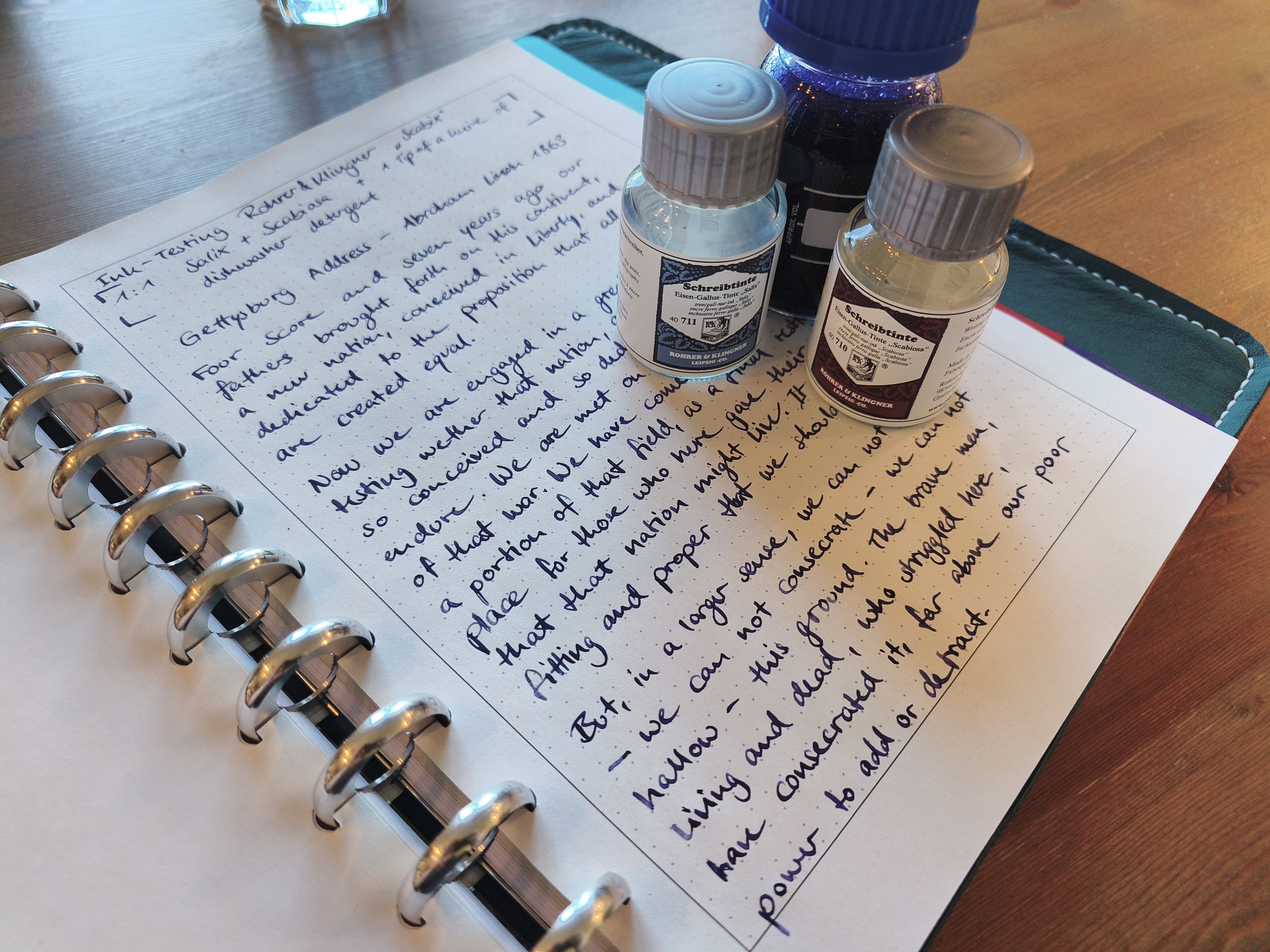
I have been using Rohrer & Klingner Salix and Scabiosa for a long time — both are iron-gall inks, both are reliable, and I keep a bottle of each on the desk. So when I came across Lori Beck's ink review on the desk of lori, describing a greyish blue-purple with a vintage character, and realized it was simply the two inks I already owned mixed 1:1. I instantly loved the color!
The first mix: the colour was right, the writing wasn't#
| Component | Amount |
|---|---|
| Rohrer & Klingner Salix (blue-black) | 50 ml |
| Rohrer & Klingner Scabiosa (blue-violet) | 50 ml |
50 ml of each into a small bottle — a 1:1 mix, just like in Lori's review, a 100 ml batch in my case. The mix goes by the name Scabix (Salix + Scabiosa), which Brad Dowdy coined years ago. Straight away I liked it better than either parent: a deep blue with a visible violet cast, drying noticeably darker — the colour matches Lori's description exactly. Purely visually, the mix did exactly what I hoped.
The writing was another matter. My daily writer is an Asvine V200 with a Kanwrite flex nib, and the plain mix writes too dry on it: the tines don't get fed enough on fast or wide strokes, and thick lines break apart into white slits — railroading. A flex nib is merciless here: it pumps a lot of ink in the downstroke and almost none on the upstroke, so flow behaviour matters much more than with a stub or fine nib. Mixing two inks I already liked did not change a thing about that.

Then: a knife-tip of dishwasher detergent#
My fix was embarrassingly simple — a small knife-tip (roughly 1–2 g) of plain dishwasher detergent powder, stirred into the 100 ml bottle until dissolved, mixed further by tilting gently. Do not shake: foam in the feed means stuttering and blobs.
Dishwasher detergent is built around surfactants; it lowers the surface tension of the ink. In practice I see two effects, and both point right at the symptoms above:
- the ink flows better — it wets the tines and the paper more readily, the feed keeps up with the hungry flex nib, and the lines stop railroading
- the ink lays down a more saturated, more intense colour — wetter ink deposits more dye/pigment per stroke, so the written line is noticeably fuller
A knife-tip in 100 ml is deliberately conservative. More surfactant would make the ink too wet — possible bleeding and, eventually, foam-related flow problems. If you try this, start with noticeably less than a full dishwasher dose and test.
What this does to the pH#
Both parents are iron-gall inks, so the mixture is acidic — and dishwasher detergent is anything but. Typical dishwasher powders are built on soda and silicates and mix up strongly alkaline, so the honest question is what the combination ends up as.
My back-of-the-envelope answer: the additive almost certainly swallows the ink's acidity. The absolute amount of acid in an iron-gall ink is tiny — a 100 ml batch at roughly pH 3 holds only a fraction of a millimole of free acid, plus a modest buffer from the gallic and sulfonic acids. Even a real knife-tip (0.5–1 g) of alkaline powder carries several times that amount in base. So Scabix after the additive is likely no longer acidic — somewhere around neutral, quite possibly mildly alkaline. I have not measured this yet; a strip of pH indicator paper (range 4–10) settles it in five minutes, and I intend to check.
If the estimate is right, three consequences follow:
- Faster, deeper colour development. The browning-to-black chemistry — iron(II) oxidising to iron(III) tannate — speeds up as pH rises, which fits the more intense lines I see after the change.
- Shorter shelf life in the bottle. An iron-gall solution above neutral oxidises faster and can drop iron-hydroxide sediment. Another reason for the rule above: mix only what you use up, and don't store batches for months.
- Pen and paper are not the worry. Near-neutral pH is friendlier to a fountain pen and to paper than the acid it replaces (acid-catalysed ink corrosion is the failure mode of acidic iron-gall writing); the risk here is sediment in the feed, not corrosion.
How Scabix writes now#
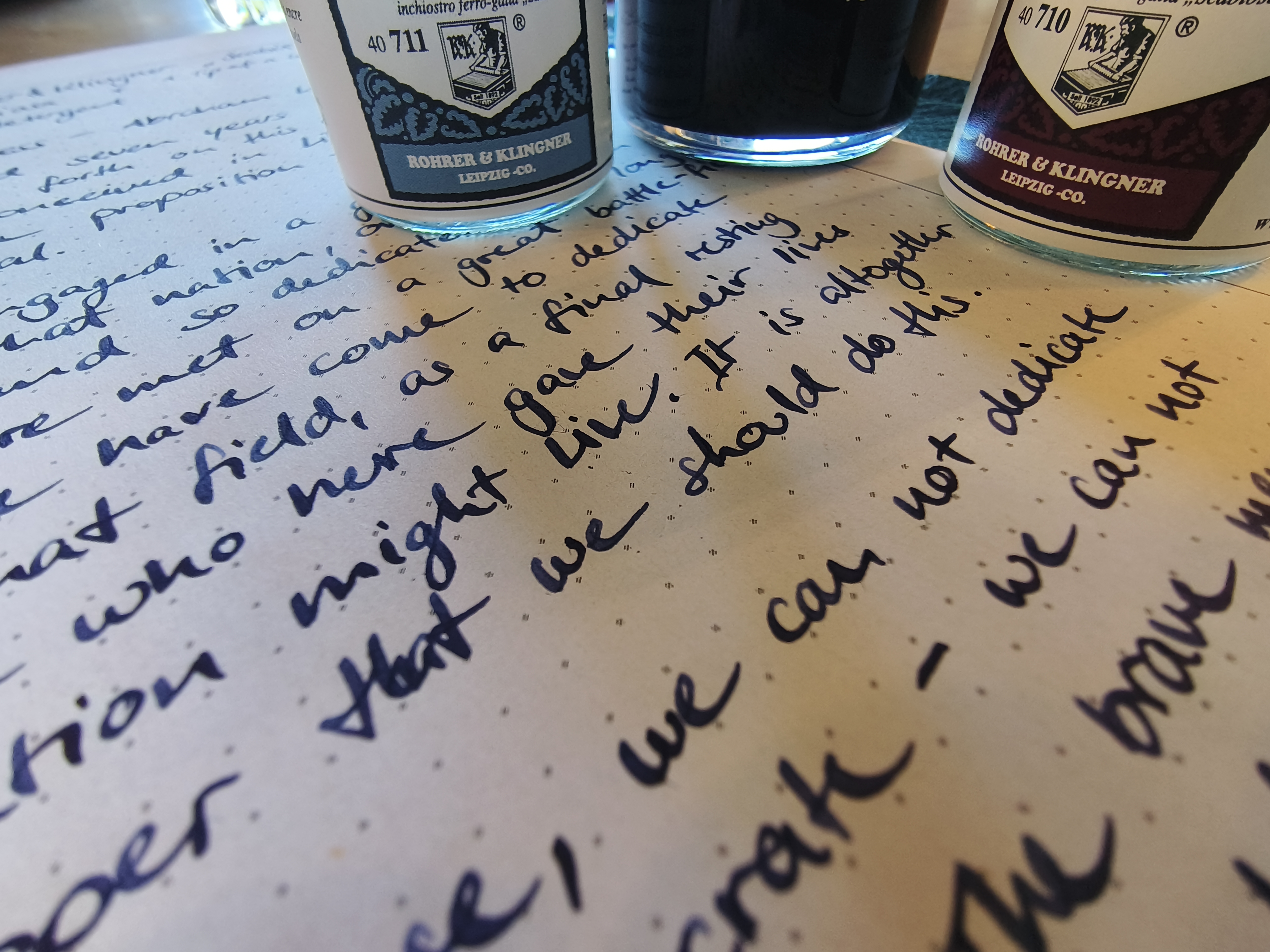
On the Kanwrite flex nib the detergent does the work: full, wet strokes without the white railroads, and the colour comes out more intense than the plain mix.
The one real trade-off: Scabix takes noticeably longer to dry than the mix without the additive. Lori reported a fairly quick dry time for the plain mix — with the detergent, that is the one thing that got worse. With a knife-tip the slower drying is manageable, but it is worth knowing before you write on slick paper or close a notebook quickly.

Caveats#
- Longer drying time is the price of the added surfactant — give the page a moment, especially with the generous ink flow of a flex nib.
- Surfactants can slightly change water resistance and how the ink behaves with liquids on top — I have not stress-tested this yet.
- The pH picture above is an estimate, not a measurement; treat the neutral-to-alkaline claim as my best reading of the numbers until a strip says otherwise.
- A dirty pen matters more with homemade mixes: flush the Asvine regularly, because detergent residue and iron-gall sediment build up differently than with a single factory ink. Modern iron-gall inks are far less aggressive than vintage ones, but flushing is still the habit to keep.
- Salt/soap compatibility of mixed inks over long storage is not fully predictable — I mix batches I can finish within a reasonable time rather than bottling litres of it.
Status#
A working recipe out of daily use, not a lab result — the photos above are the current batch on dotted paper with the Asvine V200 flex. If you try it, use a pen you wouldn't mind sacrificing, and mix only what you can use up.
One year from now. I get through roughly 100 ml of ink a year, so this very batch doubles as the durability test: around autumn 2027 the bottle should be empty or nearly so, and I intend to update this post with what a year of use did to the mix — any colour shift in the bottle, sediment, smell, and whether flow and drying held up or degraded. Until then, treat everything above as a snapshot of daily use, not a long-term verdict.